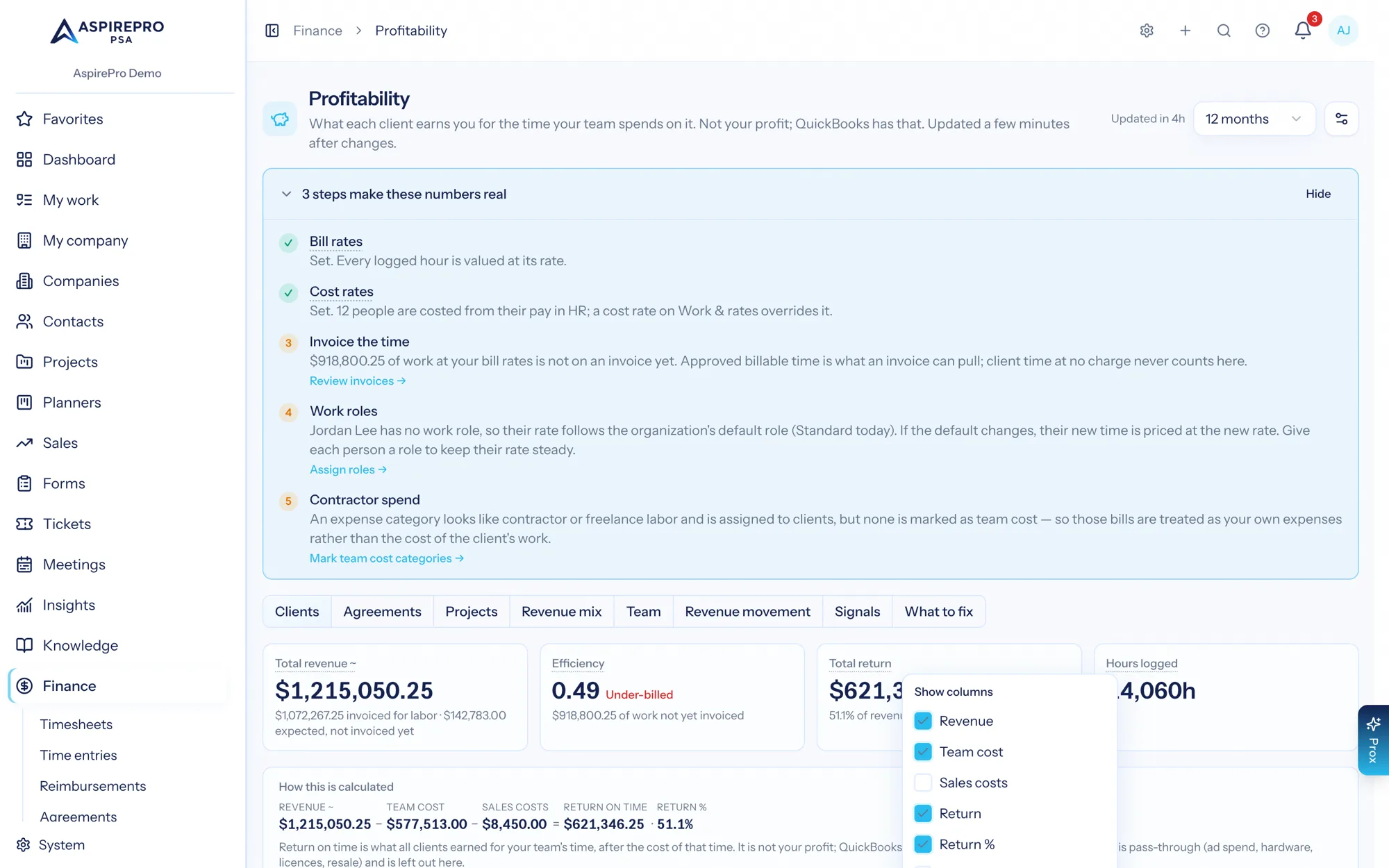
Efficiency answers a question every services business has before it has cost rates: are we billing what our time is worth? It is the second tile on Finance → Profitability, a column on the Agreements tab and an optional one on Clients, and it works the day your team starts logging time.
The calculation#
Efficiency = Labor invoiced ÷ Work at bill rates- Work at bill rates — every hour logged for the client, valued at the bill rate on its entry when it was logged. Billable and non-billable hours count: on a fixed fee the hours someone marked non-billable are exactly the ones this figure exists to see. The Bill rates row of What's behind these numbers lists the rates in force and links to where they are changed.
- Labor invoiced — what was invoiced for labor in the period, before sales tax. Pass-through lines are left out: expense lines, products, and any catalog item or invoice line marked pass-through (ad spend, hardware, licences, hosting resale). See Counting revenue.
- Invoiced only, whatever "Count revenue from" says. On the blended setting an uninvoiced time-and-materials month's expected revenue is its work value, and every such client would score a perfect 1.0 for having billed nothing. So Efficiency ignores that setting.
Reading it#
Efficiency | Reads | Means |
|---|---|---|
under 0.8 | Under-billed (red) | The client took more time than it paid for. Either the fee is light for the hours, or time is going unbilled. |
0.8 – 1.2 | On target (green) | You billed roughly what the time was worth. |
over 1.2 | Above the hours (blue) | A fixed fee earned more than its hours would have billed. A description, not a warning — value-priced work lives here on purpose. |
— · $X not yet invoiced | Work has been logged and nothing invoiced for it. There is no ratio to show; the amount is the billing gap. Client time at no charge isn't part of it: that was given away by choice. | |
Not measured yet | The month was built before the value of the work was measured. The next nightly update fills it in. |
The bands are MSPCFO's practice (median around 1.2, healthy range 0.8–1.5), and the red band is also a signal — Billed less than the work was worth — with its own editable floor.
What it is not#
- Not return. Return on time subtracts what your team's time cost; Efficiency compares what you invoiced with what the time was worth at your prices. A client can be on target and still lose money if the people behind the hours are expensive, and that is what Return is for. Nothing about Efficiency enters Return.
- Not utilization. Utilization asks how much of the team's capacity was used. Efficiency asks whether the used hours were billed.
By kind of business#
- Retainer (fractional CIO, marketing retainer). The fee is fixed, the hours vary. Efficiency drifts below 1.0 in the months the client leans on you and above it in the quiet ones. A retainer sitting under 0.8 for a quarter is priced for a smaller client than it has become.
- Fixed-fee engagement (a penetration test, a website build). Invoiced as a deposit and a balance while the hours land in between. Read it over the engagement, not the month: widen the period to 12 months on the Agreements tab and the deposit month, the quiet middle and the balance month sum to the truth.
- Time and materials. Efficiency should sit near 1.0 once the time is invoiced; anything lower is unbilled hours. Until the invoice goes out the tile says how much is waiting.
- Agency with pass-through. A $10,000 invoice carrying $7,000 of media spend is $3,000 of labor invoiced. Mark the media buy pass-through on its catalog item once and every invoice it lands on is counted right.
Worked example — a new organization's first week#
Four billable entries, 24 minutes in all, on a project for Northwind Group, at the $150 Standard rate. No invoice yet.
Work at bill rates  0.4 h × $150 = $60
Labor invoiced      $0
Efficiency          — · $60 not yet invoiced
The Revenue tile reads $60, marked Estimated in the panel because none of it is invoiced; Return reads Team cost not set because no cost rate exists yet. Once the time is invoiced, Efficiency becomes 1.0; once a cost rate is set, Return appears.
Worked example — Rivera Group, June 2026#
The reference month from the rest of this section: 165 logged hours across three people, worth $24,750 at bill rates; $22,500 invoiced for labor, plus a $1,200 product line that is pass-through.
Labor invoiced      $22,500   (the $1,200 product line is left out)
Work at bill rates  $24,750
Efficiency          0.91 · On target
Rivera's retainer is holding up: the hours it absorbed were worth about a tenth more than it paid, inside the on-target band.