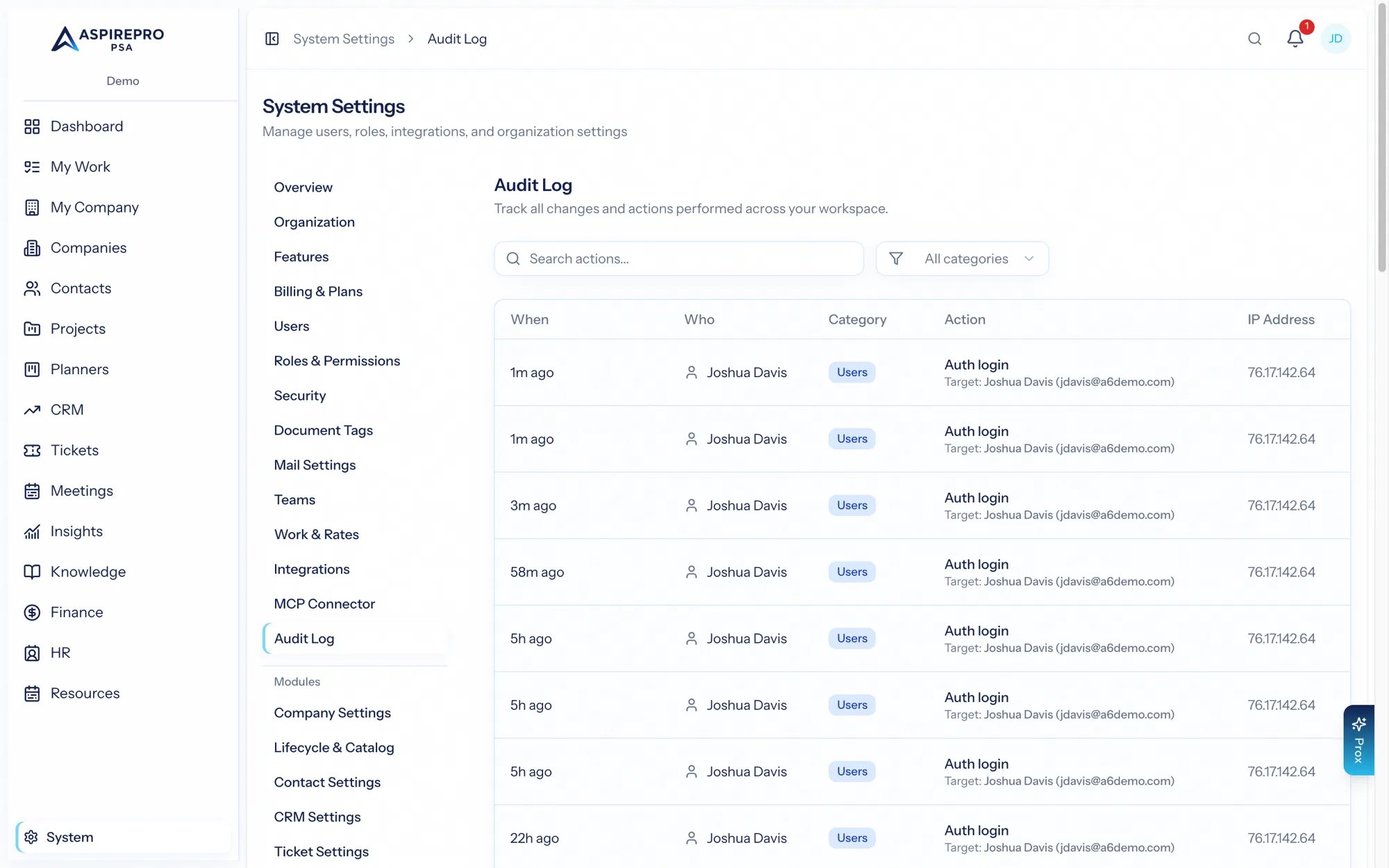
System → Audit log gives administrators a organization-wide record of significant changes — who did what, and when. It's your source of truth for accountability, compliance, and answering "what happened here?"
What the audit log captures#
The audit log records meaningful actions across the organization — changes to records, configuration, access, and other consequential events — each stamped with the user, the action, the target, and the time. Entries are immutable: they can't be edited or removed, so the log is trustworthy after the fact.
Money is audited end to end. Every financial mutation leaves an entry with its before-and-after values: agreement create/edit/status changes and default switches, draft invoice edits down to individual line items, payments recorded and removed (with the stated reason), voids, timesheet and expense approvals, reimbursement decisions, quote conversions, and the configuration behind all of it — agreement types, statuses, templates, payment terms. The nightly automations write their own entries too, attributed to the system rather than a person, so an agreement that expired or an invoice that went overdue on its own still says so.
Using the audit log#
Open System → Audit log and filter to narrow in on what you're investigating — by user, by time, by the kind of change. Common uses:
- Accountability — confirm who changed a setting, reassigned an owner, or altered a record.
- Troubleshooting — trace when something changed to explain unexpected behavior.
- Compliance — demonstrate that changes are tracked and attributable.
Record-level audit#
Beyond the organization-wide log, individual records carry their own Audit tab — companies, contacts, deals, tickets, projects, Pro Cards, and more — showing the change history for that specific record. A company's Audit tab includes its invoices, so a billing question is answered without leaving the client. When you're focused on one record, its Audit tab is the quickest path; when you're investigating across the organization, the System audit log is the place.
Because the audit log is immutable and comprehensive, it pairs with roles and security to complete your governance story: roles limit what can happen, security protects sign-in, and the audit log records what did happen.